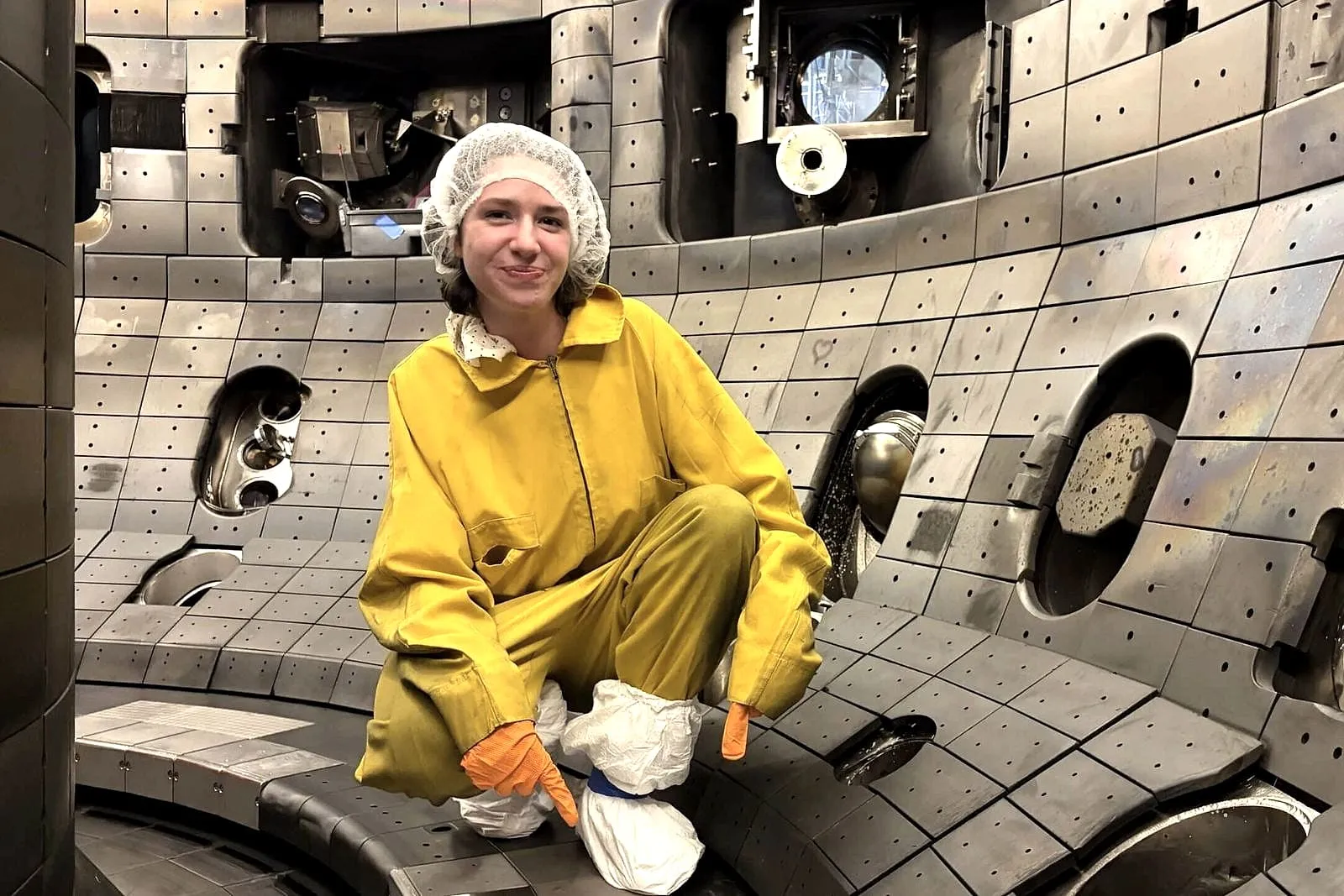
NC State University, Oak Ridge National Laboratory and JEOL have printed full-size tungsten divertor tiles by electron-beam powder bed fusion and run them through 74 high-confinement “H-mode” plasma discharges in the DIII-D National Fusion Facility in San Diego, installed in the tokamak’s lower divertor in July.
The divertor takes the brunt of the plasma’s exhaust heat. Future power plants need tiles holding steady loads of 10 to 20 megawatts per square meter, and tungsten melts at 3,422°C but cracks below roughly 200 to 600°C, which is why most laser-printed tungsten parts have come out porous and cracked. EB-PBF keeps surrounding material above 1,400°C during the build, avoiding that failure mode.
| Metric | Value |
|---|---|
| Discharges survived | 74 (H-mode) |
| Heat flux in 2025 button tests | ~20 MW/m² |
| Full-size tile dimensions | ~140 x 130 mm |
| NC State’s prior largest tungsten print | ~50 mm |
| Project timeline, invite to installation | ~8 months |
Printed buttons tested in DIII-D in 2025 held up under heat fluxes near that 20 MW/m² target with minimal surface damage, which moved the team to full-size tile testing starting in December. JEOL printed flat and domed designs on its JAM-5200EBM system in Akishima, Japan, with ORNL funding fabrication; NC State finished the parts by wire EDM and CNC grinding.
Sandia’s Jonathan Coburn, who led the tile testing, said the AM tiles “performed really well” from what the control room could see. ORNL’s Michael Kirka framed it as moving tungsten AM “from ‘promising’ to ‘proven’ for fusion,” while NC State’s Florian Laggner said the point of exposing the tiles in a live tokamak was generating survivability and erosion data that lab furnaces can’t produce.
Erosion rate, mass loss, porosity and density figures for the printed tungsten have not been published.