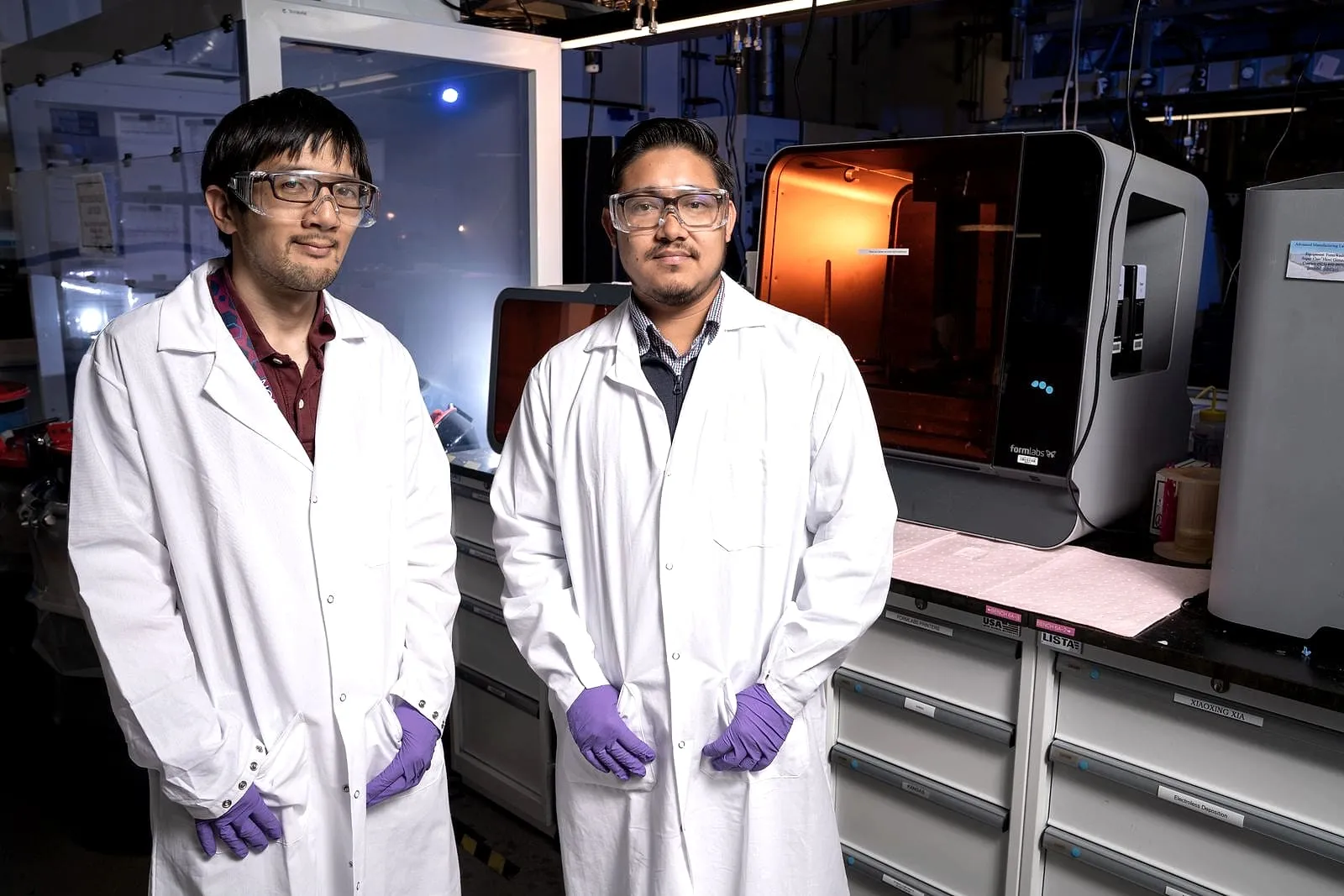
Researchers at Lawrence Livermore National Laboratory printed a solid-state bioreactor that converts waste methane into succinate, a chemical used in polymers, drug stabilization and food flavoring. The team reports it outperforms conventional liquid-state bioreactors by more than 10 times while drawing less power.
The target gas is the methane that landfills and wastewater treatment plants routinely flare off rather than capture, burning away its energy value. Conventional gas fermentation struggles here because liquid-phase bioreactors are bad at getting a poorly soluble gas like methane to dissolve and reach the microbes fast enough. LLNL scientist Fang Qian, the study’s corresponding author, points to that mass-transfer bottleneck as the reason liquid systems stay slow.
The fix skips the liquid tank entirely. The team 3D printed thin lattice scaffolds and packed the scaffold walls with a hydrogel loaded with methanotrophs, bacteria that eat methane directly. LLNL scientist Nathan Ellebracht described swapping the usual “big tank of broth” for thin printed walls that put more microbe surface in direct contact with gas.
| Detail | Value |
|---|---|
| Performance vs. liquid-state systems | more than 10x |
| Power use | lower than liquid-state systems |
| Starting reactor volume | 2 mL |
| Scaled-up volume | 1 L |
Engineer Hawi Gemeda credited the lab’s additive manufacturing setup for letting the team iterate on material, print method, geometry and performance modeling together, which sped up testing across reactor sizes from 2 mL to 1 L. Scientist Samantha Ruelas noted the microbes do the conversion without added heat or pressure, undercutting the cost structure of chemical processes that only pay off at large scale. Ellebracht argues that gap is exactly where this fits: small landfill or wastewater sites that chemical plants never scale down to serve. Qian says the group is now applying the same solid-state approach to aerobic sugar fermentation, another process limited by gas mass transfer.
No cost-per-unit-succinate figure, reactor material specifics, print method, or peer-reviewed publication details were given.