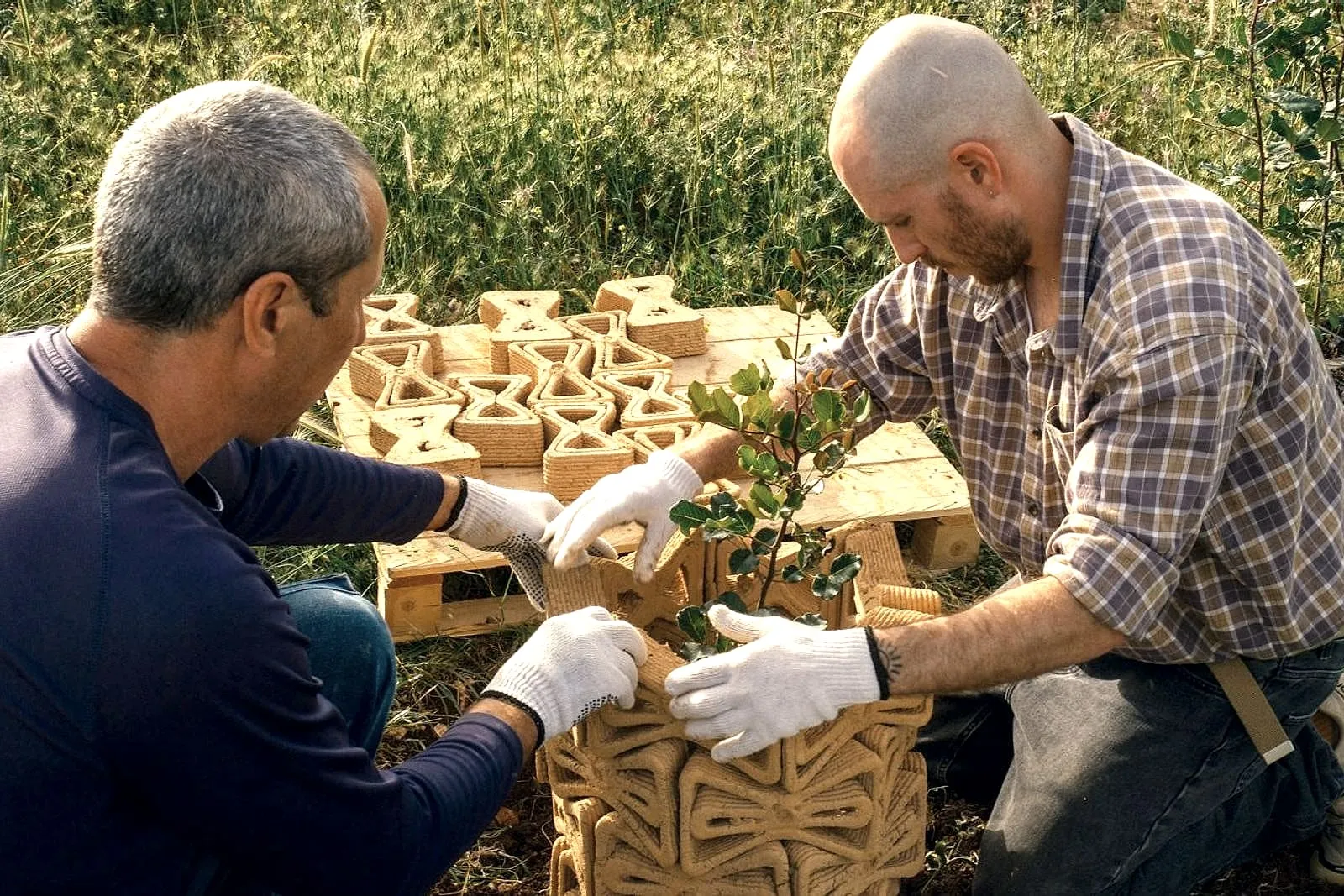
The Material Topology Research Lab (MTRL) at Technion, working with the Weizmann Tree Lab, printed 178 earthen bricks for BUSTAN, a full-scale pavilion shown at The Circle exhibition at Design Museum Holon. The bricks are made mostly from soil collected locally, mixed with bio-based plant fibers and mineral binders, turned into an extrudable paste and laid down layer by layer by a robotic arm through a custom nozzle.
Each brick carries one job: shading, thermal mass, airflow, moisture retention, or habitat space for plants and insects. The team gave each type its own toolpath and surface texture to match that function, rather than printing a uniform unit repeated 178 times. Thick earthen sections are meant to absorb heat by day and release it at night; openings near the top are meant to drive passive stack ventilation; a layered soil profile in the planting zone is meant to hold moisture through capillary action. Some bricks shade the root zone of the pavilion’s central living olive tree directly.
The fabrication work, done at the Technion Advanced Construction Center, covered soil sourcing, material testing, binder formulation and robotic programming as one pipeline. VoxelMatters’ report gives no brick dimensions, no print time, no paste composition ratios, and no load or thermal measurements, so the project is presented here as a design and fabrication prototype, not a tested building material system. The project’s own framing treats the pavilion as something meant to weather and be inhabited over time, not a fixed object, so the microclimate claims are untested at unveiling.