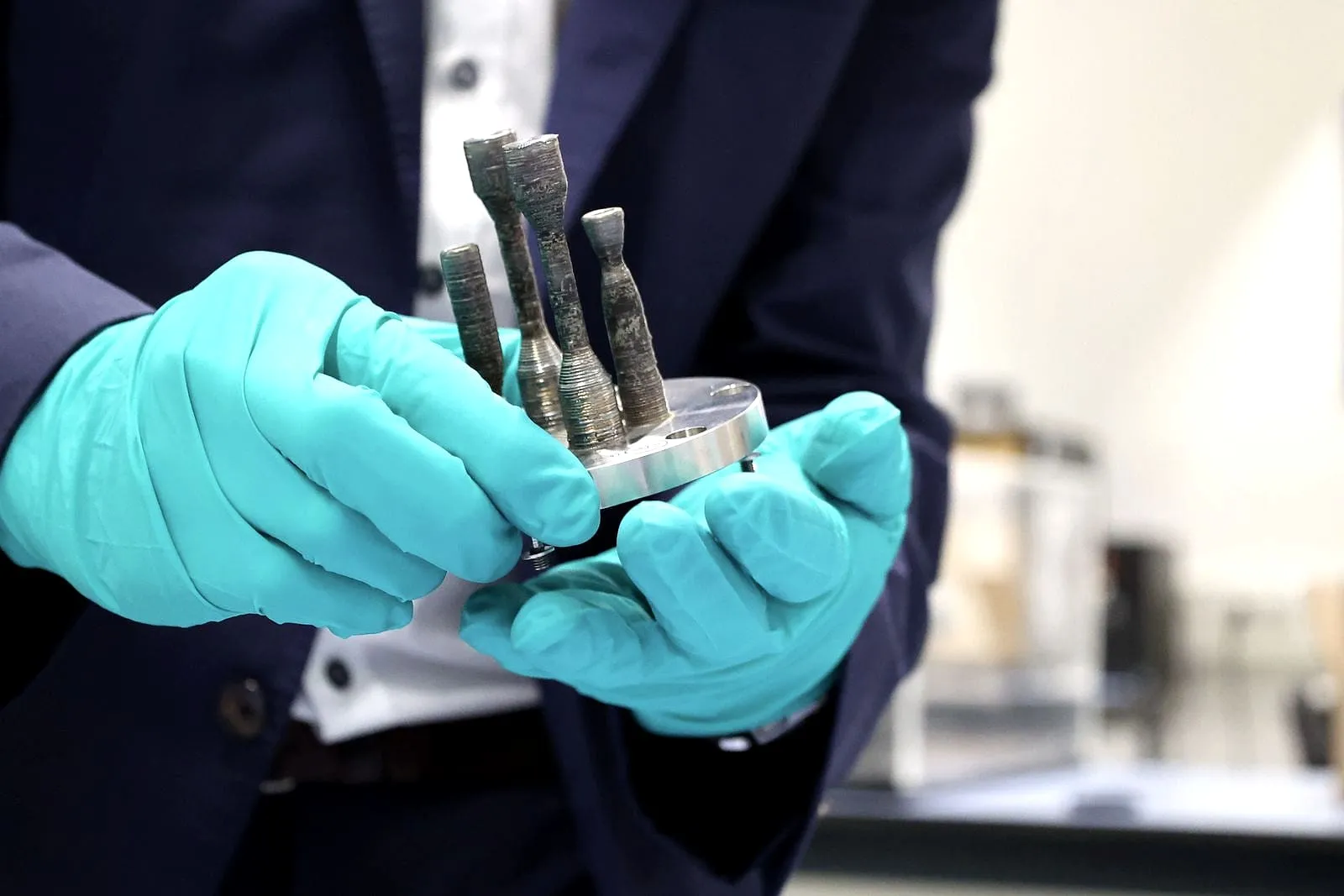
ESA astronaut Sophie Adenot retrieved the fifth metal sample from the agency’s 3D printer aboard the ISS in July, and it’s the first to include thrusters made in space. The sample had four parts: two larger test pieces and two smaller thruster components designed by the German Aerospace Center (DLR) for satellite propulsion.
The printer, installed in the station’s Columbus module, launched in January 2024 and produced its first complete sample a few months later, the first metal part ever made in space. Material scientists at ESA’s ESTEC center in the Netherlands studied that first part to see how microgravity affected the print process, then fed those findings into the procedure used for the two larger parts of this fifth sample.
DLR built two versions of the thruster. One follows the target geometry as closely as the process allows; the other has thicker walls so the inner diameter can be machined afterward. “We have designed two versions of the thruster,” said Florian Merz, a DLR research associate and test engineer, describing the near-net-shape part and the one meant for post-processing.
Both will go through hot-fire tests at DLR’s vacuum test bench in Lampoldshausen, Germany, under what the agency calls representative operating conditions, to check whether the space-printed parts hold the precision and temperature and pressure tolerance propulsion hardware needs. DLR project manager Sonja Steinbach said the tests will also compare the space-built thrusters against equivalent parts printed on Earth, to isolate what microgravity actually changes in the finished part.
No hot-fire results, no printer specs, and no thruster dimensions or material have been published yet.