4.2 mm in CAD keeps 90% of an M3 insert's pull-out strength, CNC Kitchen finds
Model the hole for a standard M3 heat-set insert at 4.2 mm in CAD and you keep about 90% of the maximum pull-out force a hole of any size in that sweep produced, somewhere around 1,400 N, roughly 150 kg. That number comes from one test: CNC Kitchen melted nearly 50 M3 inserts into PLA samples with hole diameters stepped from 3.6 mm up to 4.6 mm (the outer diameter of the insert’s knurling), three samples per diameter, printed on a Prusa CORE One L in Polymaker PolySonic PLA, then pulled every one of them out on a tensile tester.
The result isn’t a straight line. Force stays close to flat at the small end of the range, drops slowly through the middle, then falls off sharply once the hole opens up past about 4.1-4.2 mm. On that printer, with that filament, printed holes came out about 0.25 mm smaller than the CAD value, which is why a 4.2 mm model produces a hole that behaves like roughly 3.95 mm in the plastic. At that actual size, CNC Kitchen reports the insert pre-seats cleanly by hand, no burr pushes out the back when it melts in, and the pull-out strength still sits around 90% of what the undersized holes at the small end of the sweep produced.
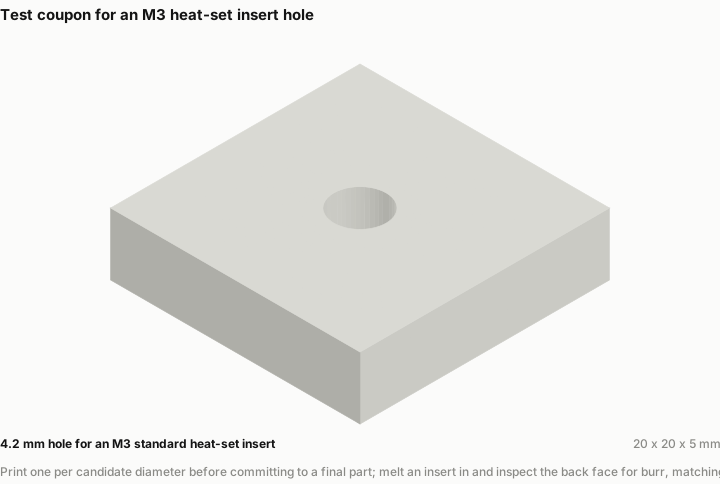
Download the part as an STL, 20 x 20 x 5 mm.
CNC Kitchen also ran a second version of the test with holes drilled to their exact nominal diameter instead of printed, to separate the hole-size effect from the printer’s own undersizing. On those drilled samples the big drop in strength happens between 4.1 mm and 4.2 mm actual diameter, which is the detail that validates the 4.0 mm hole diameter printed on the company’s own insert packaging. High-speed footage at 6,000 fps run alongside the pulls showed the brass doesn’t bond to the plastic at all; it locks into the knurling mechanically, rotating slightly in the hole in the instant before it lets go.
Where the published figures disagree
A hole-diameter sweep only answers half the question, because the insert itself is a variable too. CNC Kitchen’s own earlier insert test, a straight brand comparison rather than a diameter sweep, printed the hole size the brand gave where there was one and guessed it from the insert’s own geometry where there wasn’t, then pulled the result on a DIY tensile rig using an Original Prusa and Prusament PLA.
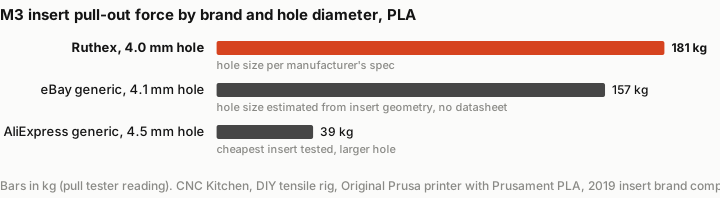
A Ruthex insert, installed in the 4.0 mm hole the brand specifies, held an average of 181 kg before it pulled free, with the surrounding plastic staying intact. A generic insert sourced from eBay, where no datasheet existed and the hole size had to be guessed from the insert’s outer geometry at 4.1 mm, averaged 157 kg. A cheap insert bought on AliExpress, melted into a 4.5 mm hole, averaged only 39 kg, a drop of more than four times relative to the Ruthex number despite the larger hole.
That spread matters more than any single hole-diameter figure. The two tests aren’t answering the same question: the diameter sweep holds the insert and material constant and varies only the hole, which is the right test if you’ve already picked an insert and just need to know what to type into CAD. The brand comparison holds the hole size roughly matched to each insert’s own spec and varies the insert, which is the right test if you’re deciding what to buy in the first place. Of the two, the diameter sweep is the one worth trusting for the CAD number itself, because it isolates a single variable with a controlled sample size on one insert and one material; the brand test is the one worth trusting for the decision not to buy the cheapest insert on the shelf, because a bigger hole made the AliExpress part weaker, not stronger, which rules out hole size as the explanation for why it failed early.
Printed hole undersizing isn’t a fixed constant either, and this is where a lot of generic advice quietly goes wrong. On the Original Prusa with Prusament PLA, CNC Kitchen measured a 0.1 mm undersize, so a nominal 4.0 mm hole needed to be modeled at 4.1 mm. On the CORE One L with Polymaker PolySonic PLA, the same company measured 0.25 mm. Same brand of printer family, different machine and filament, more than double the compensation needed. Accu’s own pilot-hole chart, for instance, lists a flat 4.0 mm for PLA, ABS, PETG and nylon alike, which is the manufacturer’s nominal insert dimension, not a tested value for your printer. It’s a starting point, not a result.
What the sweep doesn’t cover
The entire diameter sweep was run in one material, PLA, with one insert geometry, on one printer. Nobody has published the same 3.6-4.6 mm sweep in PETG, ABS, or glass- or carbon-filled nylon, all of which behave differently around a soldering iron tip and shrink differently as they cool around the brass. The practical effect is that every number in this post describing a specific diameter-to-force relationship holds for PLA and needs re-verifying, not estimating, if you’re printing the part in anything else.
Powder-bed processes aren’t covered by the sweep at all. Sculpteo ran a separate pull-out test on heat-set brass inserts embedded in MJF PA12 parts, five specimens per configuration across M2 to M6, and measured an M3-long insert at 1,258 N, recommending a working load of about 420 N in pure tension once a safety factor of three is applied. That’s a single data point in a different material and process, not a diameter sweep, so it tells you MJF nylon is in the same rough strength class as PLA for this insert size, and nothing about how sensitive an MJF hole is to being 0.2 mm too big or too small.
Resin is a bigger gap still. Heat-set inserts aren’t melted into resin parts at all, because resin doesn’t flow the same way under a soldering iron tip; CNC Kitchen’s own installation guide says inserts have to be glued in instead, ideally into a stepped hole, with thick CA glue or two-part epoxy. No pull-out figure for the glued case has been published, so there’s no number here to compare against the melted-in PLA results above, only a different installation method and a different failure mode.
Nobody has published cyclic data either: what the pull-out force looks like after the fifth time a screw has been removed and reinserted, rather than the first. Every number above, from both CNC Kitchen tests and from Sculpteo, is a first-pull result.
What to type in, and what to check after
For a standard M3 insert in PLA, start at 4.2 mm in CAD, not the 4.0 mm printed on most packaging. That number assumes a printer and filament combination that undersizes holes by something in the 0.2-0.25 mm range, which sits near the higher of the two measured cases above (0.1 mm and 0.25 mm) but is not guaranteed to match yours.
Before committing to a production part, print a small test coupon with two or three candidate diameters around that starting point, the way CNC Kitchen’s own test specimens work, melt an insert into each, and check the back face. A burr pushed out underneath means the hole was still too tight; a hole with no resistance as you pre-seat the insert by hand, before the iron ever touches it, means the hole is already too loose and you’re trading away some of that 90%. If you change printer, filament, or insert brand, re-run the coupon rather than reusing the old number, because both of CNC Kitchen’s tests show that offset moving by more than double between two closely related PLA setups.
Sources
- https://www.cnckitchen.com/blog/are-our-heat-set-insert-datasheets-wrong
- https://www.cnckitchen.com/blog/threaded-inserts-for-3d-prints-cheap-vs-expensive
- https://www.cnckitchen.com/blog/tips-and-tricks-for-heat-set-inserts
- https://www.sculpteo.com/en/3d-learning-hub/design-guidelines/pull-out-resistance-of-threaded-inserts-testing-and-results/
- https://www.accu.co.uk/p/488-threaded-insert-hole-size-charts-for-3d-printing-pla-petg-resin
- https://www.printables.com/model/707184-ruthex-practice-and-measurement-tools