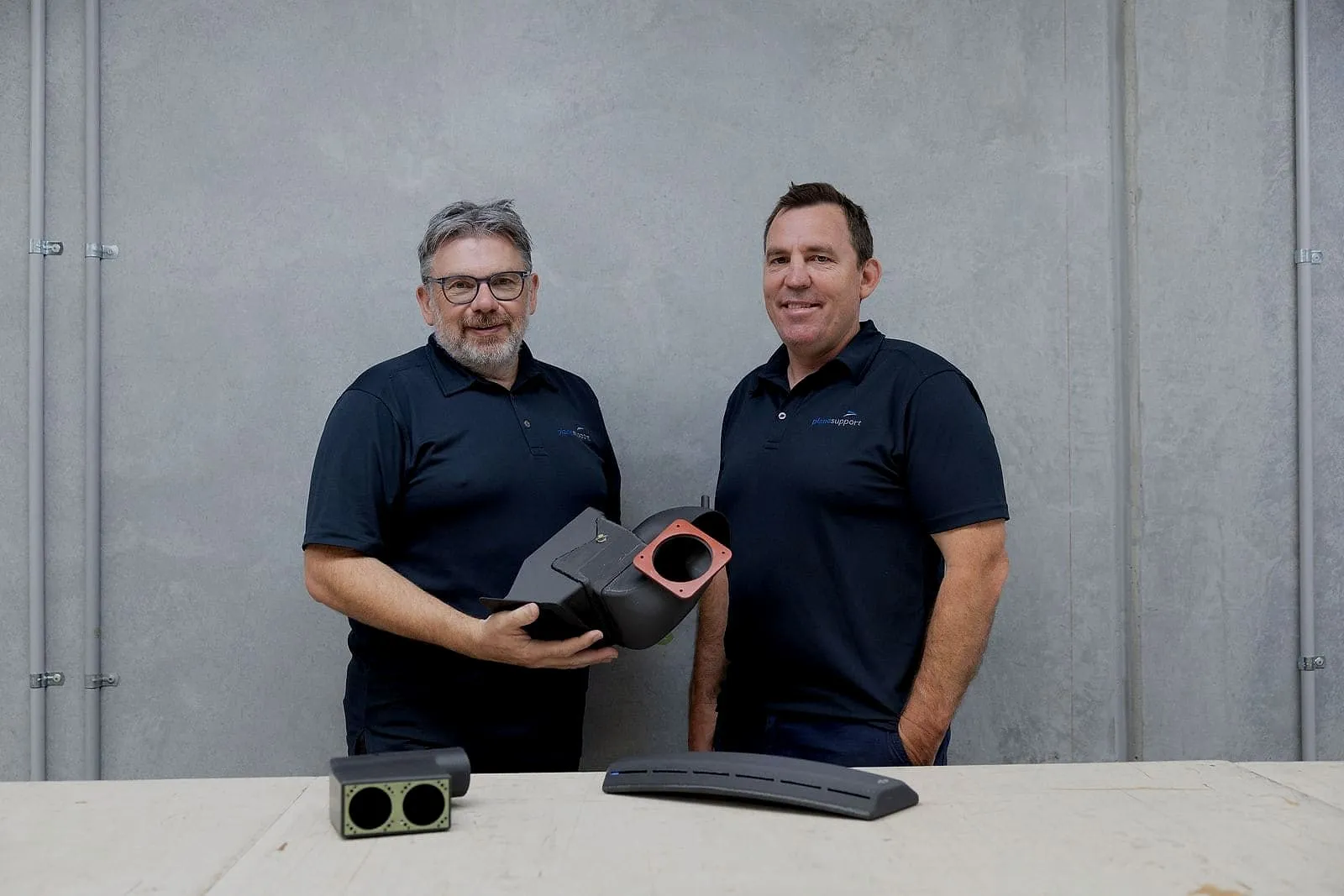
Australian firm Plane Support has received Civil Aviation Safety Authority (CASA) approval to manufacture cabin air-conditioning ducting for the Bell 214B helicopter using additive manufacturing, under CASA’s Australian Parts Manufacturer Approval (APMA) framework. The approval closes out a project that ran almost two years, started by McDermott Aviation, the world’s largest operator of the 214B and holder of its Type Certificate.
McDermott runs 15 Bell 214Bs and 14 Bell 214STs among a fleet of more than 50 aircraft, and initiated the project because some 214B components were hard to source. Founder John McDermott put the logic plainly: “An aircraft waiting on a component you can’t easily get hold of is an aircraft that isn’t working.”
Plane Support 3D scanned original ducting to build digital models, then reverse-engineered the parts for additive manufacturing while keeping original form, fit and function. The company built a dedicated aerospace additive manufacturing lab around the Markforged FX10 platform for the work, and had to develop its own quality systems, production controls and inspection methods from scratch to satisfy CASA airworthiness requirements, since no established process existed for this kind of part.
Director of Engineering Jason Hazell said the shapes proved harder to replicate than expected: “Ducting sounds simple until you try to reproduce it.” He said the procedures and inspection methods built for this approval now give the company “a pathway for other components and other aircraft types,” expanding Plane Support’s existing CASA Part 21K additive manufacturing scope.
The companies have not disclosed a unit cost or production rate for the duct. McDermott is separately preparing to produce a modified Utility 214ST model.