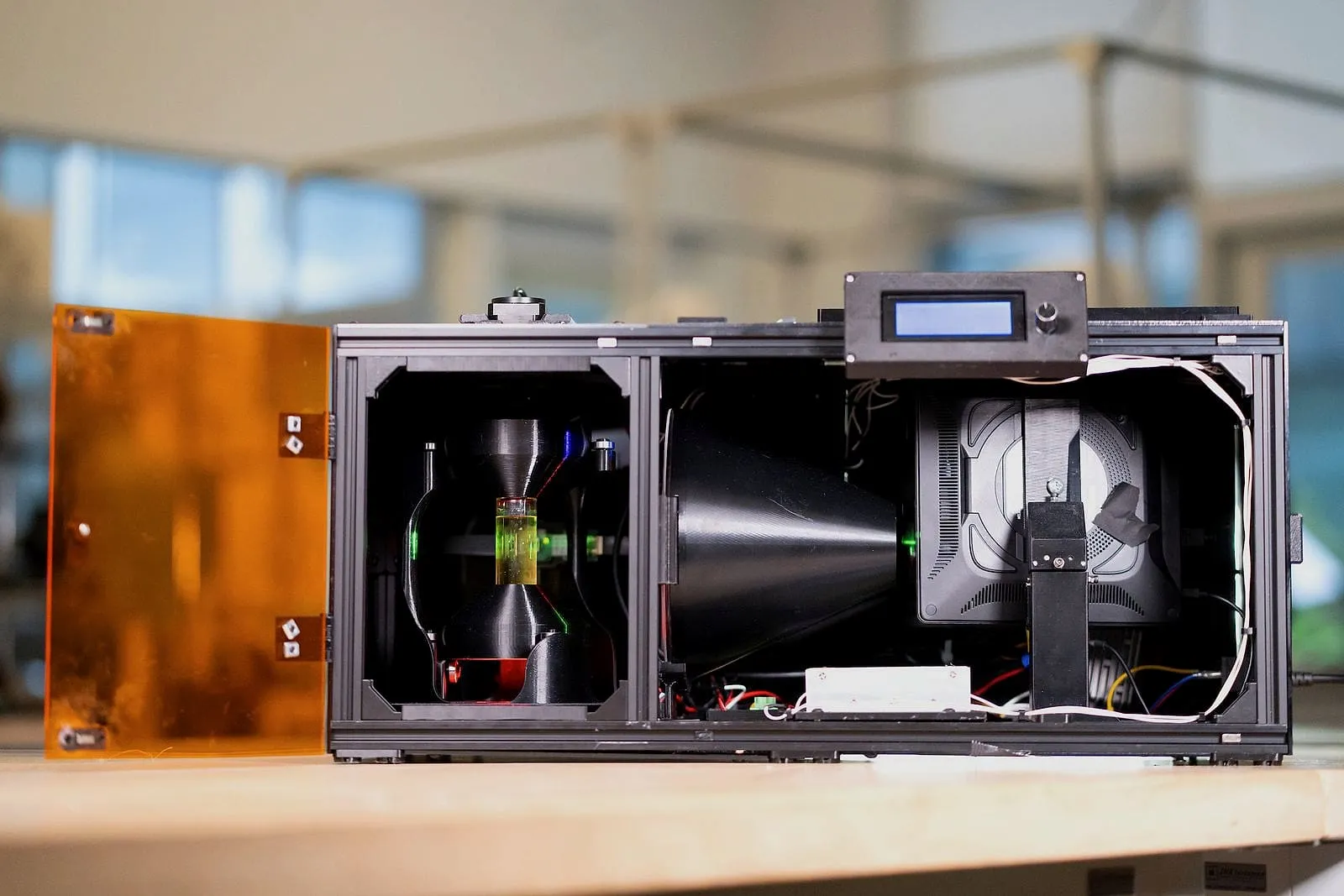
UC Berkeley has released OpenCAL, a build-it-yourself volumetric 3D printer that cures an entire object at once inside a rotating vial of resin, with Formlabs manufacturing the photopolymer and Prusa Research selling it. The lab says a typical print finishes in one to two minutes; a Rodin’s Thinker replica used as the reference part formed in 90 seconds.
The process is Computed Axial Lithography, invented in Professor Hayden Taylor’s lab in 2017 with Lawrence Livermore National Laboratory and published in Science in 2019. A projector fires a changing sequence of light patterns into a spinning vial of photosensitive resin, and the resin solidifies wherever the accumulated light dose crosses a threshold, meaning no layers, no support structures and no moving print head. Taylor Waddell led the two-year project with more than 40 contributors, mostly Berkeley students.
| Spec | Value |
|---|---|
| Print time | 1-2 minutes typical, 90 seconds for reference part |
| Hardware BOM | ~$1,638 (June 2026 pricing) |
| Assembly time | 5-6 hours, one person |
| Resin price | $119.99 per 1 L bottle (Prusa/Printed Solid, US) |
| Compute | Raspberry Pi 5 plus consumer LED projector |
Before OpenCAL, home volumetric printing meant mixing resin by hand from lab chemicals. Formlabs now produces the UDMA-based formulation at production scale as OpenCAL Resin, with the recipe still published for labs that want to mix their own. Prusa lists every printable part on Printables, hosts the hardware under its Open Community License (OCL 1.1), and printed the prototype parts on a Prusa CORE One. Print files come from Tomo, a free Windows app built on the open-source VAMToolbox library.
Machines are reportedly running or under construction at MIT, Purdue, Lawrence Livermore and NIST, and the project’s Discord has more than 2,200 members. Berkeley will run a build workshop at its VAM27 symposium in February 2027.